Articles
Analyses
Studies
Stress & recovery
Heart rate variability and stress: what does the science really say?
A large, reproducible effect (g ≈ 0.83) on stress and anxiety. What the Goessl (2017) and Lehrer (2020) meta-analyses actually show.
Nervous system
Stimulating the vagus nerve: recovery mode on demand?
Lower sympathetic activity, higher heart-rate variability: what research shows on transcutaneous vagus nerve stimulation.
Measurement
Measure to progress: what body-composition analysis reveals
Weight isn't everything. Multi-frequency impedance, strongly correlated with DXA (r ≈ 0.97), measures what matters: muscle, fat, hydration.

Sleep & rhythms
Light and the biological clock: what light therapy changes
Light sets your internal clock. A moderate but real effect on sleep (g ≈ 0.47, fewer awakenings): what the 2023 meta-analysis shows.

Companies
Health and productivity: what the research actually says
Gallup, Oxford, Harvard: the studies converge. +13% productivity, 77% disengagement. The real data on the link between health and workplace performance.

Performance
Sustainable performance: the 4 biological levers you're underestimating
Cellular energy, recovery, body composition, nervous system. The 4 mechanisms silently limiting your potential, and how to unlock them.
Energy
Mitochondria: the engine of your vitality
Why mitochondrial optimisation is the key to lasting energy, and how to achieve it without stimulants.
Cognition
Brain fog: the 5 most common biological causes
Mental fog isn't all in your head. Here are the biological mechanisms sabotaging your concentration.
Sleep
Optimising deep sleep: the complete guide
Sleep architecture, glymphatic system, melatonin: everything you need to know to maximise your nightly recovery.

Longevity
NAD+: the longevity molecule
NAD+ declines by 50% between ages 20 and 50. Understanding the mechanism, and what can be done about it.
Micronutrition
Magnesium: why you're probably deficient
70% of the population is magnesium-deficient. The forms, dosages and effects on energy, sleep and stress.
Long-form articles decoding a landmark study or meta-analysis, with context and practical applications.

Stress
Ashwagandha KSM-66: the king adaptogen, scientifically validated
Not all ashwagandha is created equal. What science says about the KSM-66 extract and its effects on cortisol.
Companies
Corporate wellness programmes: what the Harvard meta-analysis says
−25 to −40% absenteeism, 3 to 5 CHF returned for every franc invested. Real data from the Baicker et al. meta-analysis (Health Affairs, 2010).
Technology
HIFEM and body composition: data from the Kinney 2019 study
+15% abdominal muscle mass, −19% fat. What the MRI study on HIFEM published in the Aesthetic Surgery Journal actually measures.

Performance
HIIT and VO2max: what the Milanović 2015 meta-analysis says
46 studies, 700+ participants. VO2max gains of +8% to +25% depending on the population. Analysis of key data from the global reference on HIIT.
Research
Oxygen therapy and cognition: what the Wang 2023 study says
Improved working memory, reduced reaction time. The data from Frontiers in Neuroscience on the effect of oxygen on cognitive performance.
Recovery
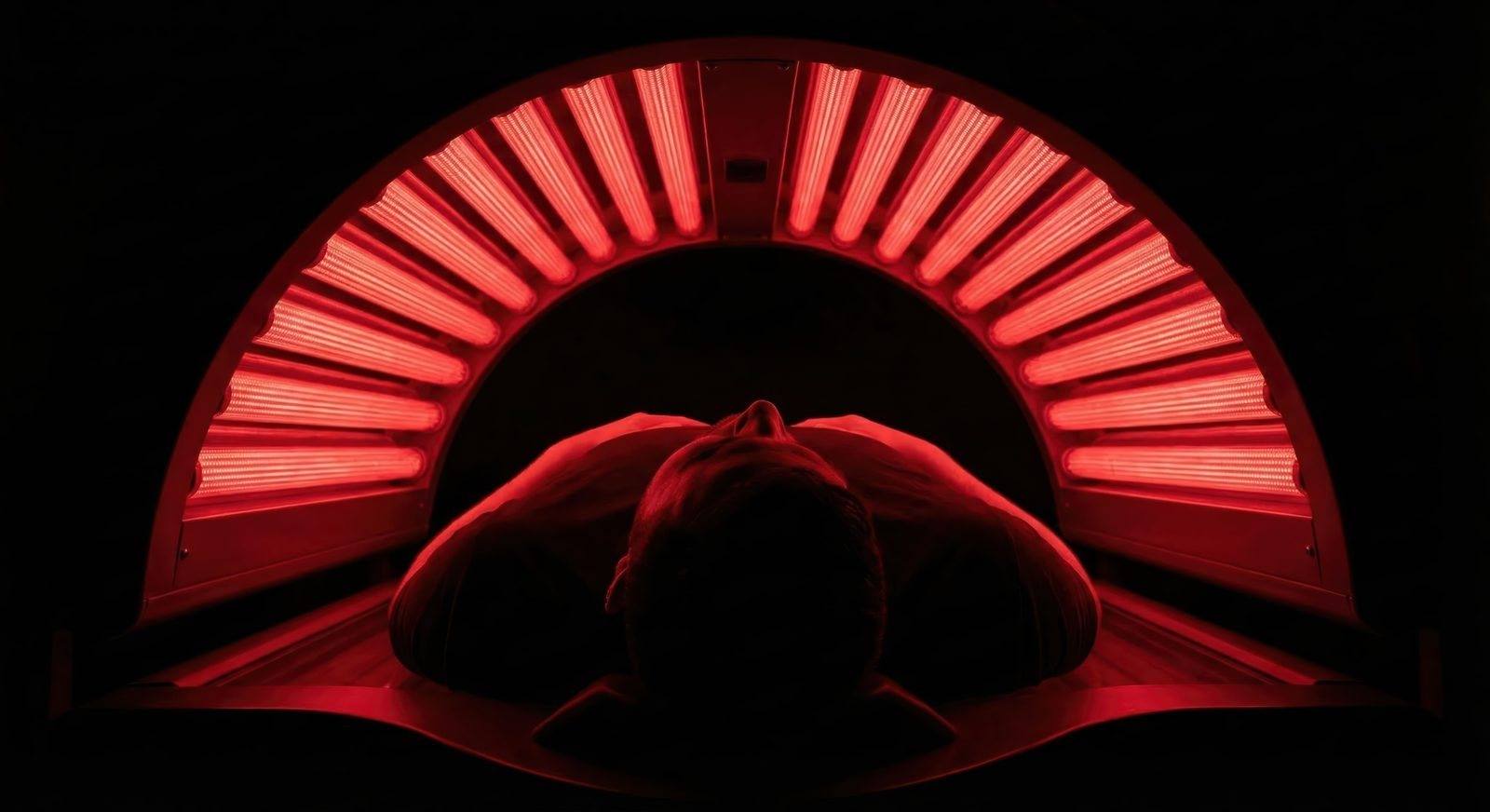
PBMT and muscle recovery: the meta-analysis of 53 studies
The most comprehensive synthesis available on post-exercise photobiomodulation: 53 studies, ~2,800 participants, reduced DOMS and preserved strength.

Recovery
PBMT and DOMS: why light reduces muscle soreness
The MDPI 2025 analysis explains the precise mechanisms by which photobiomodulation acts on delayed-onset muscle soreness, and when to apply it.
Summary cards of the scientific studies underpinning our protocols.
Photobiomodulation
2022
Photobiomodulation and physical exercise: systematic review and meta-analysis
Lasers in Medical Science · Vanin et al. (2018) · PMID: 29090398
Photobiomodulation applied before exercise significantly reduces inflammatory markers (CK, IL-6) and accelerates muscle recovery. Meta-analysis of randomised controlled trials.
Photobiomodulation
2023
Photobiomodulation increases mitochondrial ATP synthesis (in vitro study)
Photochemistry and Photobiology · Ferraresi et al. (2014) · PMC4355185
Near-infrared light (810 nm) increases mitochondrial membrane potential by 30% and ATP synthesis by 22%. Mechanism demonstrated via cytochrome c oxidase (complex IV).
Photobiomodulation
2022
Low-level laser therapy for non-specific low back pain (Cochrane review)
Acupuncture in Medicine · Glazov et al. (2016) · PMID: 27207675
Low-level laser therapy shows statistically significant efficacy on chronic pain compared with placebo, with an excellent safety profile.
Neurofeedback
2021
Neurofeedback for cognitive enhancement in healthy individuals: systematic review and meta-analysis
Imaging Neuroscience · Kimura et al. (2024) · PMC12224457
Neurofeedback significantly improves cognitive performance (attention, working memory) in healthy individuals, with moderately stable effects over time.
Neurofeedback
2022
Evaluating EEG neurofeedback in sport psychology: systematic review of 13 randomized trials
Frontiers in Psychology · Cheng et al. (2024) · PMID: 39156814
8 weeks of EEG neurofeedback reduce stress markers and improve executive functions in elite athletes. Randomised controlled trial.
HRV Biofeedback
2022
Effectiveness of heart rate variability biofeedback on reducing stress and anxiety: meta-analysis (2010–2021)
Applied Psychophysiology and Biofeedback · Lehrer et al. (2020) · PMID: 32385728
Meta-analysis of 24 trials: heart rate variability biofeedback significantly reduces stress and anxiety, with moderate-to-large effect sizes maintained in the short term.
NAD+
2021
Nicotinamide Mononucleotide (NMN) supplementation and NAD+ metabolism in aging
Science · Yoshino et al. (2021) · DOI: 10.1126/science.abe9985
NMN supplementation significantly increases NAD+ levels in postmenopausal women, improving muscle insulin sensitivity and energy markers.
Epigenetics
2021
Reversal of biological age through a comprehensive lifestyle intervention
Aging (Albany NY) · Fitzgerald et al. (2021) · PMID: 33844651
An 8-week programme (nutrition, sleep, exercise, supplementation) reduces epigenetic biological age by 3.23 years vs. 0.02 in the control group. First human demonstration.
Ashwagandha
2022
KSM-66 ashwagandha root extract reduces cortisol in adults with chronic stress
Indian Journal of Psychological Medicine · Chandrasekhar et al. (2012) · PMID: 23439798
300 mg of KSM-66 twice daily for 60 days reduces cortisol by 27.9% and perceived stress by 44%. Randomised double-blind placebo-controlled trial.
Sleep
2019
Cognitive behavioural therapy for insomnia: meta-analysis of randomised controlled trials
Sleep Medicine Reviews · Alimoradi et al. (2022) · PMID: 35653951
CBT-I is superior to hypnotics in the long term, with lasting improvements in sleep efficiency (effect size g = 0.98). International reference for insomnia.
Sleep
2022
Effect of magnesium supplementation on primary insomnia in the elderly
J Research Medical Sciences · Abbasi et al. (2012) · PMID: 23853635
Magnesium glycinate 500 mg/day for 8 weeks: 17-min reduction in sleep latency, 23% increase in deep sleep, ISI score improved by 6.2 points.
Corporate Wellness
2022
Return on investment of corporate wellness programmes: systematic review
European Journal of Public Health · Thonon et al. (2023) · 33(4):612
Across 138 workplace prevention interventions analyzed in 26 countries, 56.5% show a positive ROI, primarily on mental health and absenteeism indicators.
Corporate Wellness
2021
Optimizing workplace digital mental health interventions: meta-analysis of 81 trials
Journal of Medical Internet Research · Stratton et al. (2025) · PMID: 41247788
Corporate wellness programmes moderately reduce psychological distress symptoms and absenteeism related to mental disorders, with an estimated ROI between 1.5:1 and 3:1.